The Operational Challenges Every Growing Food Manufacturer Faces

.avif)
Growth in the food manufacturing process brings new operational demands. As companies add production sites, warehouses, and regional facilities, coordinating people, processes, and information becomes increasingly challenging. What once relied on a small team and familiar workflows gradually evolves into a business where every decision affects multiple departments.
This article examines how growth affects day-to-day operations, why coordination becomes more difficult, and how manufacturers connect processes, data, and teams without replacing the systems they already use.
Why Food Manufacturing Gets More Complex as Businesses Grow
In the early stages, coordination is relatively straightforward. As the business grows, however, production decisions begin involving procurement, quality, warehousing, logistics, and compliance teams, making alignment much more difficult.
Product variety is one of the biggest drivers of this shift. Every new SKU adds recipes, ingredients, packaging, suppliers, quality documentation, inventory rules, and production schedules, increasing operational complexity far beyond production volume itself.
Workforce challenges add further pressure. Deloitte and FMI found that employee turnover in food retail was already around 40% before the pandemic, while 46% of respondents said COVID-19 made hiring and retaining employees more difficult. For manufacturers, that means continuously onboarding staff while maintaining consistent processes across growing operations.
At the same time, FDA's FSMA requires risk-based preventive controls, supplier verification, and traceability, while GS1's Global Traceability Standard establishes consistent data and traceability practices across products, suppliers, and facilities. As operations expand, keeping these processes aligned becomes just as important as increasing production capacity.
The Biggest Operational Challenges Food Manufacturers Face
As food manufacturers grow, operational challenges become more interconnected. Expanding product portfolios, larger supplier networks, additional production sites, and stricter regulatory requirements all increase the effort required to keep operations running consistently.
Workforce and skills
Workforce shortages remain one of the industry's biggest concerns. Deloitte and FMI found that 44% of food companies cite labor shortages as a key challenge, 40% struggle with employee retention, and 39% say they need to retrain workers to use new technologies. UK data from the Food and Drink Federation also shows vacancy rates in food manufacturing reaching 3.9%, compared with 2.1% across manufacturing overall.
PMMI's Inside the Workforce Gap report adds another challenge: operational knowledge often stays with experienced employees instead of being embedded into standardized processes. As organizations grow, onboarding, training, and consistent execution become harder to maintain across facilities.
%20(1).avif)
Compliance and food safety
Growth also increases the complexity of food safety compliance. Under the FDA's Food Safety Modernization Act (FSMA), manufacturers must maintain documented hazard analyses, preventive controls, supplier verification programs, and corrective actions across all relevant facilities.
At the same time, Food Engineering and PMMI report growing recall pressure and stricter certification requirements, making inconsistent procedures between facilities increasingly costly. A single food safety issue at one production site can quickly affect operations across the wider network.
Traceability and operational visibility
According to GS1's Global Traceability Standard, manufacturers need consistent product identifiers and traceability records throughout the supply chain to support rapid, targeted recalls.
As businesses expand, traceability data often ends up spread across multiple systems and facilities. Investigating a quality issue may require pulling together information from spreadsheets, local databases, and emails before teams have a complete picture of what happened.
Network planning
Expansion also changes how production is planned. McKinsey notes that increasing supply chain transparency and tighter margins require manufacturers to make network-level decisions about capacity, inventory, and production allocation rather than optimizing individual facilities.
Food Engineering's State of Food Manufacturing reports that many companies continue investing in new equipment and production capacity. Without coordinated planning across sites, however, those investments can simply shift bottlenecks from one facility to another instead of improving overall operational performance.
Where Time, Money, and Productivity Get Lost
Operational complexity doesn't usually appear as a major disruption. It shows up in everyday work — longer planning cycles, more manual coordination, and slower decision-making.
Coordination takes more time than expected
As businesses grow, production schedules, inventory, supplier documentation, quality records, maintenance plans, and staffing information are managed by different teams and often stored in different systems. Managers spend more time collecting updates, checking reports, and confirming that everyone is working with the latest information. For businesses with several production sites or warehouses, even routine decisions often require information from multiple locations before action can be taken.
A multi-location food and beverage company experienced exactly this challenge. Inventory, staff onboarding, inspections, online orders, and reporting were managed through spreadsheets, forms, and email, making it difficult to maintain consistent multi-location operations. After introducing a Central Hub to connect these workflows, manual administrative work dropped by 70%, operational response became 60% faster, multi-location visibility improved by 80%, and inspection workflows became 75% more standardized. Instead of spending time coordinating information, teams could focus on running day-to-day operations.
Product variety increases planning complexity
Every additional SKU adds another layer of planning. Recipes, ingredients, packaging, supplier approvals, labels, inventory rules, and production schedules all need to stay synchronized.
As product portfolios expand, manufacturers deal with more frequent changeovers, shorter production runs, and tighter coordination between procurement, production, quality, and logistics. Research on food manufacturing consistently identifies SKU proliferation as one of the main drivers of operational complexity.
Small disruptions spread faster
Operational dependencies also become stronger as businesses expand. A delayed ingredient delivery can affect production schedules, inventory availability, quality documentation, transportation, and customer deliveries. Equipment maintenance may require production to be rescheduled across multiple lines or facilities. The more interconnected operations become, the more important it is to have visibility into how one change affects the rest of the business.
Why Food Manufacturing Software Alone Isn't Enough
Most growing food manufacturers already rely on ERP, MES, WMS, quality management software, and maintenance systems. Each type of food manufacturing software solves a specific operational problem, from production planning to inventory or quality control, but doesn't always connect seamlessly with the rest of the technology stack.
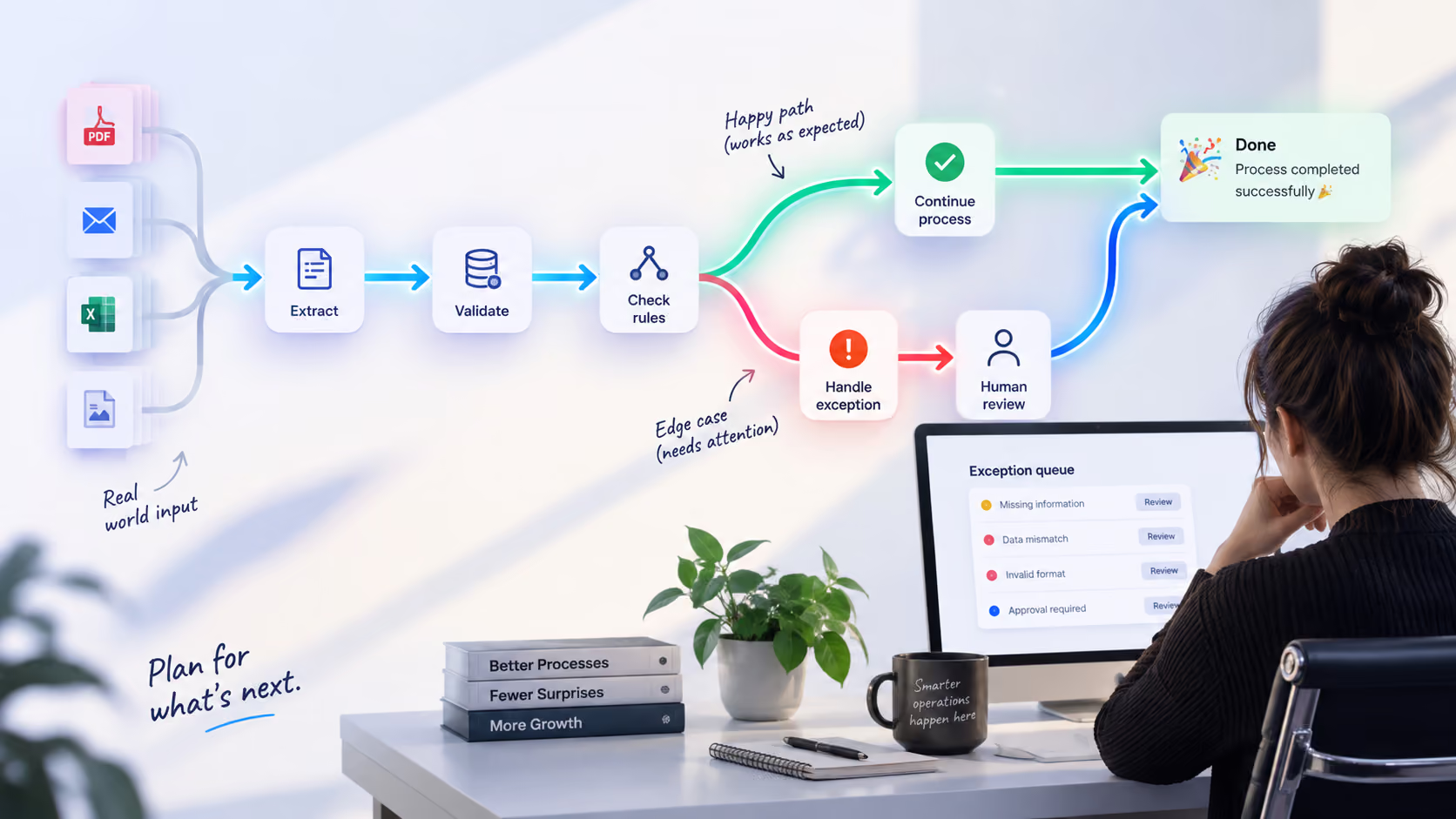
As operations grow, information becomes distributed across multiple applications. Production plans are updated in one system, supplier documentation in another, maintenance schedules somewhere else, while exceptions are discussed through email, chat, or shared documents. Finding the complete picture often requires pulling together information from several different sources.
A precision manufacturing company faced a similar situation. Quotes, work orders, production schedules, maintenance requests, shipping, and documentation were managed through separate systems and spreadsheets, making it difficult to understand the real status of operations. After connecting these workflows through a Central Hub, on-time order completion improved by 18%, scheduling response time decreased by 31%, and planning-to-execution alignment improved by 24%, while production visibility became fully centralized. The biggest improvement came from connecting existing workflows rather than replacing individual systems.
The same principle applies to food manufacturing. Food traceability, supplier verification, production planning, inventory management, and quality control all depend on shared operational information. GS1 standards and FSMA requirements reinforce the need for consistent data and documentation across products, suppliers, and facilities. When those processes remain fragmented, coordination becomes slower as the business grows.
Many manufacturers eventually reach a point where the question is no longer whether they have the right software, but whether the information flowing through those systems is connected well enough to support day-to-day operations. Business process automation can streamline individual tasks, but it doesn't automatically create a shared operational view.
%20(1).avif)
What High-Performing Food Manufacturers Do Differently
Growing manufacturers rarely solve operational complexity by introducing more software. Instead, they focus on making existing operations easier to coordinate.
They standardize how work gets done
GS1 standards show how common identifiers such as GTIN (products), GLN (locations), and SSCC (logistics units) create consistent data across the supply chain. High-performing manufacturers apply the same principle internally, standardizing products, production sites, and operational processes so dashboards, traceability reports, and performance metrics remain consistent across all sites.
The same approach extends to changeovers, sanitation, and quality checks. While individual facilities may adapt procedures to local equipment, the underlying workflows stay standardized,making it easier to compare performance, improve operational efficiency, and scale improvements across the business. This level of process standardization makes it easier to compare performance across sites.
They connect operational data
Production, inventory, quality, maintenance, procurement, and supplier management all influence one another. Bringing that information together gives teams a clearer picture of what's happening across the business and reduces the time spent reconciling reports before decisions can be made.
Cross-functional meetings also become more productive because discussions focus on priorities instead of explaining why different reports contain different numbers.
They build visibility across the entire operation
McKinsey highlights that greater visibility across the food value chain is becoming a competitive advantage. The same is true inside manufacturing operations. As businesses expand, production planning is no longer about filling next week's schedule at one facility. It becomes a balancing act across the entire network.
Instead of asking, "What can Plant A run next week?", operations teams ask, "Given today's demand and available capacity, where should each product be produced, and what does that mean for changeovers, maintenance, inventory, and labor?"
This network-wide view helps manufacturers respond more quickly to shifting demand while making better use of capacity across all facilities.
%20(1).avif)
Creating a More Connected Food Manufacturing Business
Growth changes the way food manufacturing operations are managed. More products, suppliers, production sites, warehouses, and distribution channels create more connections between teams and processes. Keeping those operations aligned becomes just as important as increasing production capacity.
Most manufacturers already have the systems they need — ERP, MES, WMS, quality management software, and other specialized tools. The challenge is creating a single source of truth so everyone can operate from the same, up-to-date picture so everyone can operate from the same, up-to-date picture.
This is where a Central Hub comes in. Rather than replacing existing software, it connects production planning, inventory, manufacturing workflows, quality, supplier management, maintenance, compliance, and reporting into one operational layer. Teams gain a shared view of operations, making it easier to coordinate production across multiple locations, maintain consistent standards, respond quickly to disruptions, and make better-informed decisions.
.avif)
For growing manufacturers, the goal is to keep operations connected as the business continues to expand. A Central Hub acts as a business operating system, connecting existing systems into one operational layer.
Ready to simplify your operations? Contact us today to learn how a Central Hub can connect your existing systems, improve cross-site coordination, and help your business scale with greater visibility, consistency, and control.

.avif)
%20(1).avif)