Food Manufacturing Automation: From Reports to AI Agents

.avif)
Food businesses run on rhythm — ingredients in, products out, and every minute in between matters. Whether it’s a café blending smoothies or a production facility packaging sauces, timing and quality decide everything.
Today, another key ingredient is joining the mix: automation.
Across North America and Europe, small and mid-sized food manufacturers are using automation not to replace people, but to remove repetitive work. From waste tracking and quality checks to compliance reporting and staff training, AI-driven systems are quietly reshaping daily operations — and freeing teams to focus on what really matters.
The Industry Shift: From Paperwork to Predictive Operations
Food manufacturing sits at a complex intersection of regulation, perishability, and customer expectations. For years, even well-run producers relied on spreadsheets, paper checklists, and shared drives.
That model breaks as soon as scale enters the picture.
Teams managing multiple locations face slow reporting, inconsistent data, and manual bottlenecks:
- Waste logs updated days later
- Quality reports buried in email threads
- Invoices typed line by line
Staff training tracked in outdated documents
Today, affordable automation platforms — Make.com, Airtable, and AI copilots — make it possible to connect these workflows without large IT systems. Reports generate themselves, data syncs automatically, and compliance tracking happens in real time.
A Practical Example: Bona Fide Juicery
Bona Fide Juicery, a Midwest organic smoothie chain with several cafés, faced a familiar problem: too many spreadsheets, too little visibility.
Each store tracked food waste manually and sent weekly reports to headquarters, where someone compiled totals and costs. The process took hours and delayed decision-making.
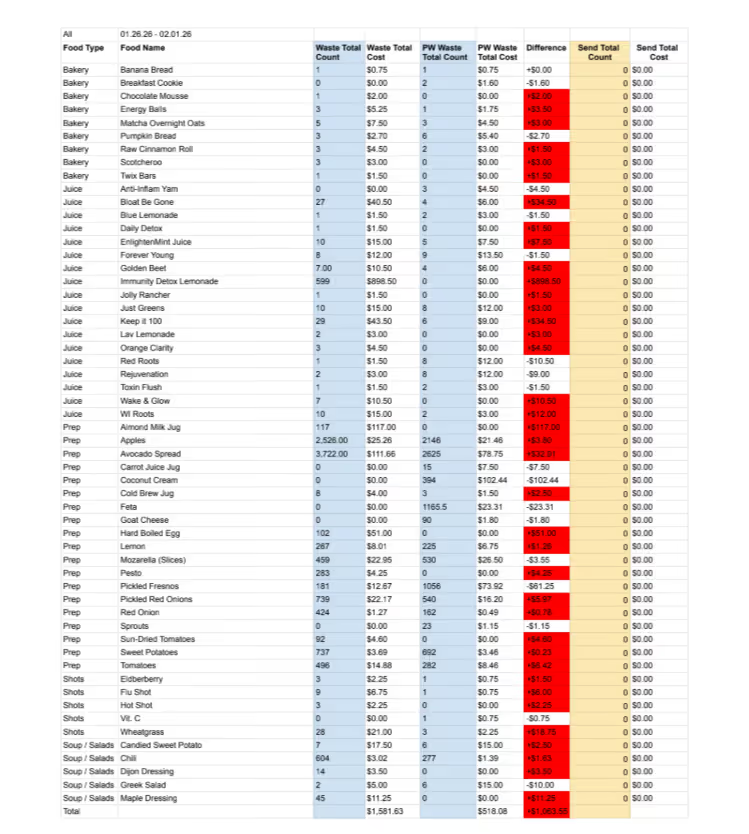
We built an automation that now runs every Monday at 6 a.m. Central Time. It gathers data from all locations, generates a clean report for each, and emails it automatically. Costs, quantities, and summaries appear instantly — no one needs to collect or format anything.
.avif)
What once started their week with admin now begins with insight. Managers review trends instead of chasing data, and small adjustments — like adjusting batch sizes — now happen faster and with evidence behind them.
Turning Lab Reports into Instant Data
A premium food producer needed a faster way to process lab test results that arrived as PDFs by email. Each report had to be opened, read, and logged manually — a slow and error-prone routine.
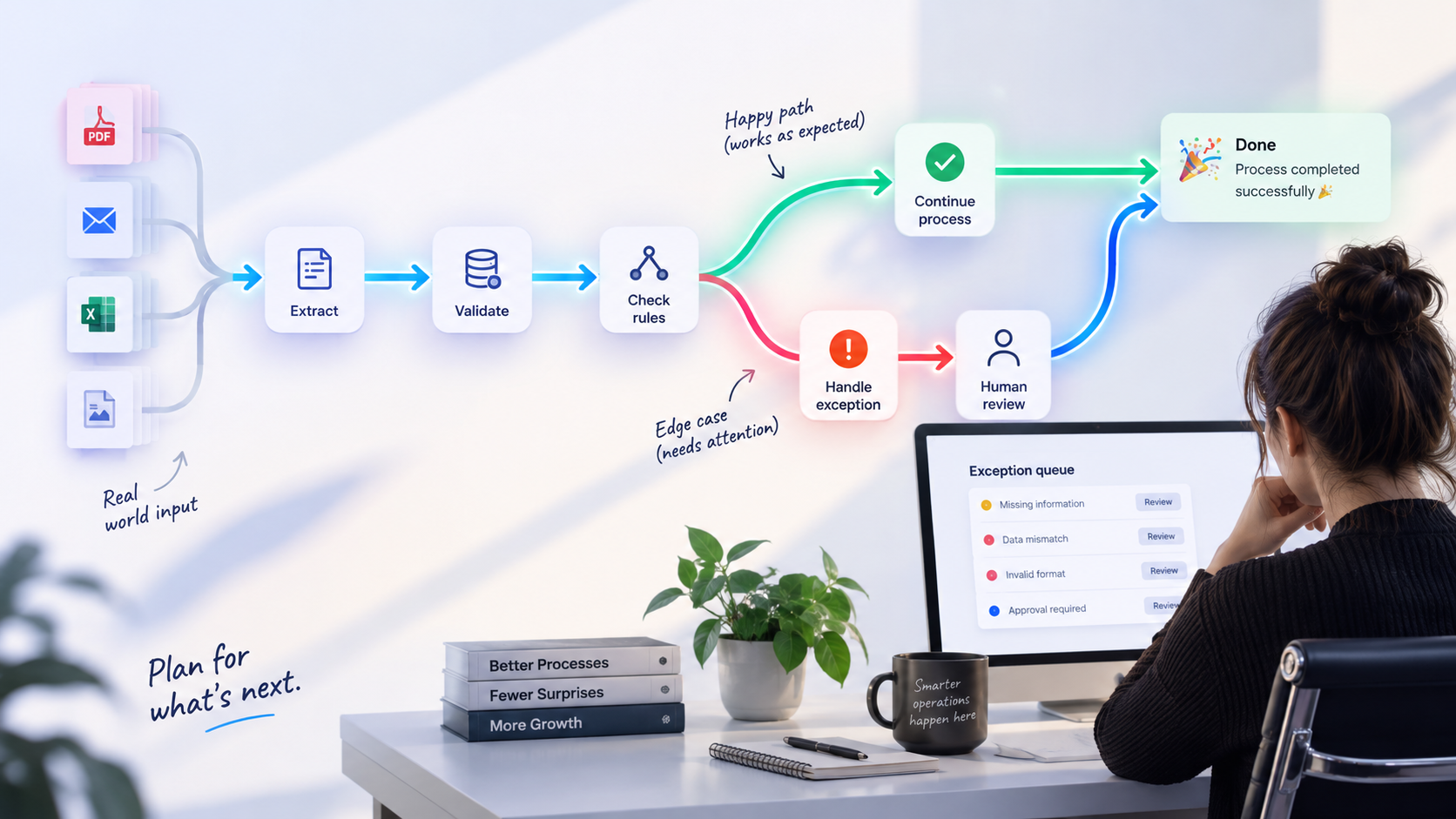
We built an AI-driven lab report automation that extracts data from incoming PDFs, structures it in a shared spreadsheet, and flags anomalies automatically. It handles multi-page and scanned files, so every test result is captured and organized without human effort.
.avif)
Lab results now flow directly into dashboards, giving managers real-time visibility into quality metrics and compliance data. The information is always current, structured, and ready to use.
Where Food Businesses Can Start Automating
Not every company needs AI robotics or predictive analytics to see impact. The biggest ROI often comes from simple, targeted automations that eliminate routine work.
1. Waste and Production Reporting
Generate weekly waste reports automatically. Collect data from POS or spreadsheets, format it, and send summaries to managers.
2. Quality Control and Compliance
Digitize quality checks and temperature logs. Store them instantly in Drive and trigger alerts when limits are exceeded.
3. Inventory & Supplier Management
Link supplier orders and stock tracking. Trigger reorders automatically when levels drop below thresholds.
4. Labeling and Batch Tracking
Print labels dynamically from production data, complete with batch ID, expiry, and traceability.
5. Team Training and Task Tracking
Turn SOPs into digital checklists. Track completion automatically and update procedures company-wide in one click.
6. Invoicing and Payments
Automate invoice creation with integrations to accounting tools. Data from sales or production triggers billing instantly.
7. Communication and Reporting
Use automation to send order confirmations, generate daily reports, and notify staff of exceptions — all from the same workflow.
Why These Automations Work
Automation succeeds when it mirrors how people already work. The best systems don’t add steps — they remove them.
At Atomic Actions, every project begins with observation. We identify repetitive, time-consuming tasks and automate the flow around them. Some take a day to build — like the waste report automation — and deliver measurable value from week one. Others evolve into larger systems: connected dashboards, predictive analytics, or AI agents that watch for anomalies.
The key is focus. Start with the tasks that repeat daily and offer clear savings in time or accuracy. Those small wins compound into lasting efficiency.
From Paper on Kitchen Wall to Digital Dashboard
Automation doesn’t just save time — it brings visibility.
When reports, compliance data, and inventory all connect, managers can see waste patterns, track performance, and plan purchasing with confidence.
Front-line teams spend less time on admin. Owners see operations clearly. Decisions get made faster because the data is already there.
And with today’s low-code platforms, implementing these systems no longer requires big software budgets or IT departments. Most food producers can digitize core processes within weeks.
The Next Step: Predictive Food Operations
As food manufacturing becomes more data-driven, AI agents are emerging as the next step — helping producers forecast demand, detect quality issues, and optimize production in real time.
Yet the principle remains the same: AI amplifies structured processes, not messy ones. That’s why every Atomic Actions implementation starts with process discovery — understanding how work really happens before turning it into code.
Some companies come to us already knowing their bottlenecks; others uncover them through this step. Either way, understanding what slows you down is what makes automation effective. Without that structure, even the best AI won’t drive real improvement — it will just move inefficiency faster.
A Note for Founders and Managers
If your food business still runs on scattered spreadsheets and manual reports, you don’t need a full ERP to modernize. Start small, automate one process, and build from there.
When the repetitive work runs itself, your team gets to focus on quality, innovation, and growth — the things no automation should ever replace.
Atomic Actions helps food and beverage companies streamline production, reporting, and compliance through automation and AI. From waste tracking to lab data management, we build systems that turn daily routines into efficient, scalable workflows.
.avif)
%20(1).avif)