Manufacturing Business Systems: A Single Source of Truth Beyond ERP


As digital manufacturing evolves, companies continue layering tools onto operations: ERP for core transactions, CRM for customer data, and production systems for the shop floor. And yet, for all that accumulated technology, the problems underneath haven't gone away: fragmented processes, data that doesn't agree with itself, decisions that arrive a beat too late.
A modern manufacturing business system is built on a different premise. Rather than adding another layer to the stack, it functions as a Business Operating System — pulling sales, production, finance, documentation, reporting, automation, and AI into a single coherent context. Not another system to log into, but the hub the whole company actually runs on: shared information, shared workflows, shared rules, no translation required between departments.
Why Manufacturing Businesses Outgrow Traditional ERP Systems
ERP platforms were built to record transactions — and they do that well. Invoicing, purchasing, inventory: structured processes with defined inputs and outputs. The challenge is no longer data capture alone but business process integration across sales, planning, finance, and production.
The data makes the gap concrete. Only a minority of manufacturers have a comprehensive digital strategy, with many still stuck trying to reconcile data and responsibilities across siloed units. Smart factory research, meanwhile, points to productivity gains of up to threefold over the next decade for companies that fully connect their operations and information flows. Closing that gap calls for a different kind of infrastructure.
A manufacturing business system connects customer demand, revenue management, and production planning software into one unified workflow.
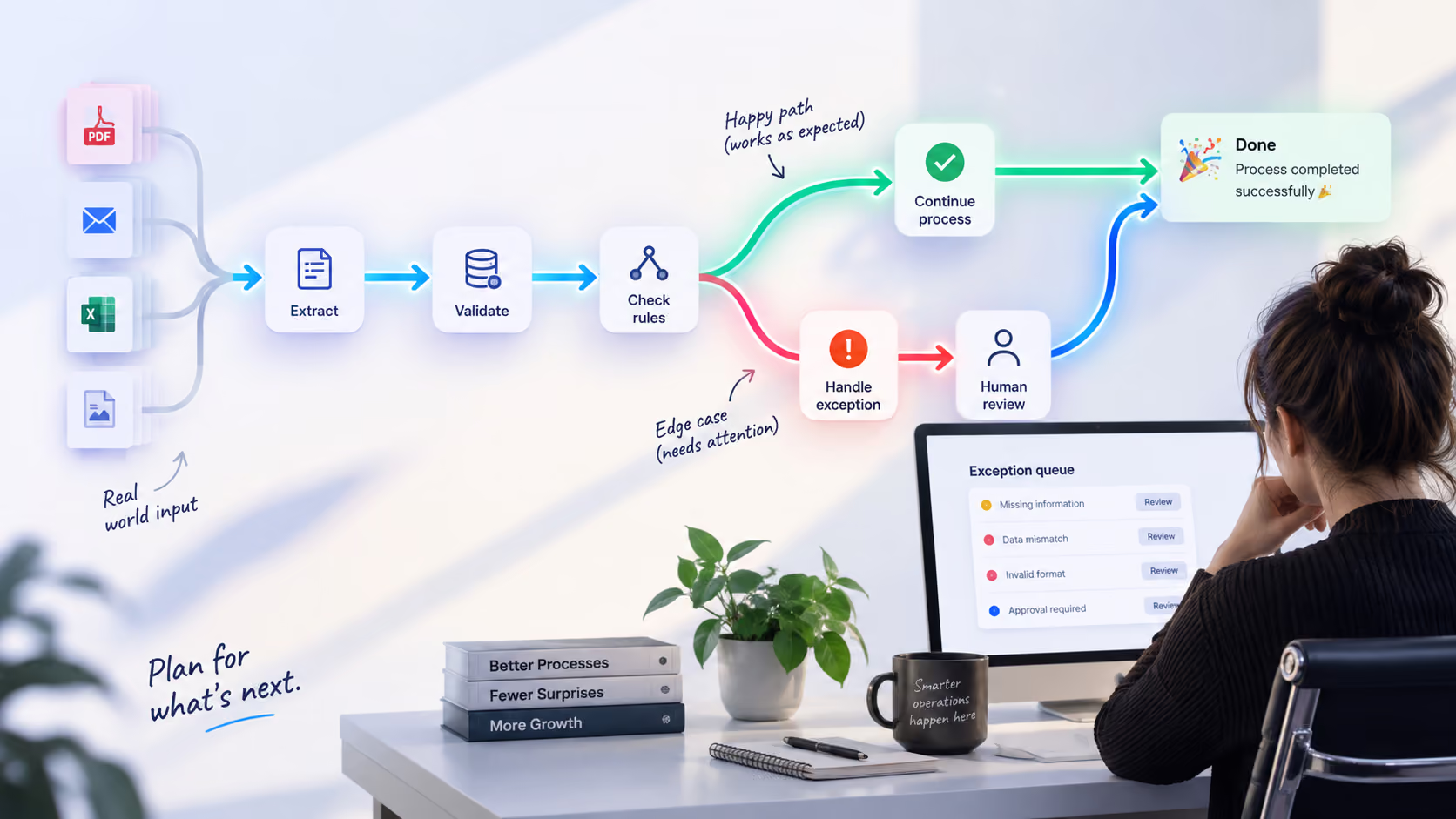
Sales commitments drive executable plans. Once a quote is accepted, the system generates work orders, updates capacity plans, and adjusts material requirements automatically — all running on shared business rules and AI-assisted models, with no manual handoff required.
Revenue and margin are calculated in real time. Sales teams can run pricing, configuration, and delivery scenarios before committing, seeing exactly how each option lands on plant utilization, lead times, and profitability.
AI in manufacturing is moving beyond analytics toward real-time planning, scheduling, and decision support. Embedded AI agents scan incoming demand, surface bottlenecks, and propose alternative schedules or product mixes to keep revenue and on-time delivery moving in the same direction.
With every team operating inside one system, there's a single, canonical answer to the question every manufacturing business runs on: what has been sold, what must be produced, and what it will cost — no spreadsheet archaeology, no reconciling conflicting reports.
Finance, Supplier Management, and Commercial Visibility
Finance and procurement are often the last to know. Controllers reconcile cost variances weeks after production has moved on; procurement finds out about material shortages when a line actually stops; commercial leaders discover margin erosion when the quarter closes and the damage is already done.
IDC research confirms that integrating operational data sources is now a top challenge for manufacturers trying to extract value from data-driven decision-making. End-to-end visibility — from operations through supply chain to sustainability metrics — keeps appearing in global manufacturing transformation studies as a prerequisite for resilient growth, not a refinement of it.
A manufacturing Business Operating System changes the timing entirely by embedding finance and supplier management into everyday operations:
- Real-time cost and margin tracking. As work orders progress, the system updates labor, material, and overhead consumption continuously — live margin visibility at the level of customer, product, and production line, not a month-end summary.
- Supplier performance in operational context. Lead times, quality metrics, and pricing are tied directly to schedules and customer commitments, so AI agents can flag risk and recommend alternative sourcing before a gap becomes a stoppage.
- Commercial visibility for leadership. Finance and operations share one view of revenue, margin, backlog, and risk — the kind of shared picture that makes pricing calls, capacity investments, and contract decisions faster and better grounded.
Financial data stops being a report extracted from ERP after the fact. It becomes part of the same source of truth driving sales, production, and strategy.
Smart Manufacturing Through Documentation and Knowledge Management
Manufacturing documentation — work instructions, change orders, quality manuals, safety procedures, compliance records — tends to end up scattered across shared drives, local folders, and point solutions that don't talk to each other. Disconnected from live operations, it stops being an asset and becomes a liability: outdated instructions cause rework, missing records, slow audits, inconsistent standards chip away at quality.
NIST's Smart Manufacturing program is direct on this point: trustworthy systems and data are essential to safely applying advanced computing in manufacturing, and "trustworthy" means documentation and operational knowledge integrated into the same system that executes and monitors production, not parked in separate repositories hoping someone remembers to update them.
Within a manufacturing business system, documentation functions as live operational knowledge:
- Work instructions tied to execution. Each operation references current instructions, checklists, and safety protocols directly from the system, so operators never fall back on outdated PDFs or local files.
- Change management linked to quality and schedule. When engineering changes are approved, AI-assisted workflows push updates to affected products, work orders, and suppliers automatically — documentation revised, impacted orders flagged, no manual chase required.
- Structured knowledge base. The system maintains a knowledge graph of best practices, root-cause analyses, and lessons learned, so AI agents can surface relevant insights to planners, engineers, or operators at the moment they're actually needed.
Documentation stops living "somewhere on the server" and becomes an active part of the business system, one that directly shapes quality, compliance, and delivery performance.
Real-Time Manufacturing Reporting and Operational Visibility
Effective manufacturing operations management depends on real-time visibility, yet many manufacturers still rely on fragmented reports and disconnected dashboards. Production metrics live in MES, financials in ERP, demand in CRM, project data somewhere else entirely and pulling a single report across those sources means manual integration and data that's already stale by the time it arrives. Digital performance management and real-time monitoring are among the key enablers that actually unlock value from modern technologies.
In a manufacturing Business Operating System, reporting is inherent to the platform:
- Unified data model. Orders, work orders, schedules, financials, supplier data, and documentation all live in a shared business schema, so metrics and definitions stay consistent across departments rather than shifting depending on who pulled the report.
- Live dashboards and alerts. Management sees current information on backlog, OEE, yield, lead times, and margin. AI agents monitor thresholds and trigger workflows the moment deviations occur, not after the morning standup.
- Contextual drill-down. Leaders can move from a corporate KPI straight to the specific customer order, work center, or supplier issue behind it — inside the same interface, without switching systems.
That visibility doesn't stop at the factory gate. It spans sales, finance, and service too, because manufacturing performance is the outcome of the entire business, not just what happens on the plant floor.
Manufacturing Automation, AI, and Workflow Orchestration
Smart manufacturing is about orchestrating people, machines, and information through intelligent workflows and business process automation across the entire organization. Traditional industrial automation stays local: PLC logic on a line, a script running in one corner of the business. Efficiency improves, but cross-functional outcomes don't necessarily follow.
McKinsey and the World Economic Forum estimate that fully implemented Industry 4.0 and data-driven operations could unlock trillions of dollars in global value through better use of analytics, AI, and connected technologies. Deloitte's smart manufacturing surveys point to significant gains as well, while flagging what makes the transformation genuinely hard: complexity of execution and the talent it demands.
An agentic, AI-assisted manufacturing business system takes on these challenges by embedding AI inside the operating environment itself:
- AI agents triggered by business events. When a large order is accepted, an AI agent analyzes capacity, supplier risk, and margin, then proposes a schedule and sourcing plan aligned with company rules. When scrap spikes on a line, another agent correlates documentation changes, supplier batches, and operator shifts to surface the cause.
- Workflow orchestration across tools. Automation lives in the Business Operating System rather than in isolated scripts, coordinating ERP, MES, CRM, and maintenance systems as parts of a single workflow engine.
- Human-in-the-loop optimization. AI augments planners, engineers, and managers with proactive recommendations, scenario simulations, and automated routine decisions — all governed by shared policies and guardrails.
The AI here isn't a separate analytics stack or a chatbot bolted onto the side. It's a set of agents operating inside the same environment that holds orders, schedules, financials, and documentation, which is what makes the approach genuinely agentic rather than just automated.
Building a Central Hub for Modern Manufacturing Companies
For manufacturing companies, the Business Operating System takes concrete form as a Central Hub: a practical implementation that unifies data, workflows, roles, and automation across the entire organization. It connects ERP, MES, and CRM into integrated business systems that operate as one coherent environment rather than isolated tools.
Earlier work on Business Operating Systems describes this evolution from workflow automation toward a central operating layer as the next stage of digital maturity. For growing SMB manufacturers, Why Growing SMBs Need a Central Hub explores how this kind of hub can sit above existing systems to coordinate processes and data without forcing a full rip-and-replace transformation.
In practice, a Central Hub for manufacturing typically includes:
- Unified work management. One system for sales orders, work orders, scheduling, maintenance, and service — as shown in the One System for Sales, Work Orders, Scheduling, and Maintenance implementation with X-CEL.
- Cross-functional governance. Shared business rules and permissions spanning departments, so changes in pricing, capacity, quality standards, or AI policies are reflected system-wide from a single point of control.
- Embedded AI and automation. Agentic workflows and AI assistants built into the same environment rather than added as ad-hoc tools, enabling the Central Hub to coordinate human and machine decisions inside one unified context.
The Central Hub is, in this sense, a concrete path for manufacturers to adopt a Business Operating System: one place where sales, production, finance, documentation, reporting, automation, and AI converge and where new technologies can be onboarded without adding another silo to manage.
Creating a Single Source of Truth Across the Entire Business
“Single Source of Truth” in manufacturing is often conflated with “central data warehouse.” While centralizing data is useful, it does not address the deeper issue: different teams executing different processes, rules, and definitions. A genuine Single Source of Truth is a business system where core information, workflows, and governance are defined and executed consistently.
In a manufacturing Business Operating System, Single Source of Truth means:
- Shared information. Sales, production, finance, suppliers, documentation, and reporting draw from the same canonical records for customers, products, orders, and assets.
- Shared processes. The end‑to‑end flow, from opportunity to cash to service, is modeled and executed in one system, with clear ownership, handovers, and automation.
- Shared rules and policies. Pricing logic, quality thresholds, schedule priorities, ESG metrics, and AI guardrails are defined centrally and applied consistently across all workflows.
AI agents operate inside this environment, using the same ontology and rules as human teams. They do not infer from partial data; they act on the same Single Source of Truth that everyone else uses. This is what truly lies beyond ERP for manufacturers: not just additional modules, but a manufacturing business system, a Business Operating System and, in practice, a Central Hub, that provides a single, reliable foundation for the entire business. Ready to move beyond disconnected systems? Get in touch to explore how a Central Hub can connect your workflows, data, and AI initiatives.
.png)
.avif)