How AI Helps Operations Teams Make Better Decisions

.avif)
A decision looks simple: expedite a shipment, change a production schedule, approve a discount. Then someone has to find the information needed to make it. Inventory is in the ERP, supplier updates are buried in emails, finance has its own spreadsheet, and the CRM holds another piece of the puzzle. By the time everything is pulled together and checked, hours may have passed.
This is where AI decision support can make a practical difference. AI can bring together information from different systems, identify patterns and risks, and prepare relevant recommendations, giving teams the context they need for faster operational decision making. The final call stays with the person responsible for the outcome.
.avif)
AI agents take this a step further by bringing analysis into the workflow itself. They can work with real-time data from connected business systems, analyze information against specific goals, and automate routine actions once a decision has been approved. This creates a more connected form of operational intelligence, where data, analysis, recommendations, and execution can work together.
What AI Decision Support Actually Looks Like
AI in operations does not have to mean a chatbot answering questions or a general-purpose tool generating text. Some of the most useful applications are much narrower and are built directly into existing workflows. This is where AI assisted decision making becomes practical: AI supports specific decisions using the data and business rules already available to the organization.
AI can help operations teams with tasks such as:
- Parsing and structuring data: turning emails, PDFs, forms, and other unstructured information into usable records
- Matching and reconciliation: identifying duplicates, resolving differences between systems, and filling data gaps
- Anomaly detection: finding unusual changes in costs, production times, inventory, quality, or other operational metrics
- Summarization: turning large amounts of information into concise briefs for decision-makers
- Recommendation generation: combining data and predefined rules to suggest possible next steps
These capabilities form part of what is often called operational analytics or AI business analytics. The purpose is not simply to produce more reports. It is to help teams understand what the data means in the context of an operational decision.
The important part is where this analysis happens. A generic AI tool often requires someone to stop what they are doing, collect the relevant information, and manually provide it with context. AI embedded into an operational workflow can work from the data that is already flowing through the business. That creates a useful sequence: AI prepares the information, a human reviews it and makes the decision, and automation can then carry out the approved action.
4 Ways AI Can Speed Up Operational Decisions
1. Turn Fragmented Data Into a Decision-Ready View
One common operational problem is that teams have plenty of data but no easy way to see it together. For example, a manufacturing business with three locations may need a daily operations report combining financial data from QuickBooks, inventory information from a custom database, shipping data from an API, and several Google Sheets maintained by shift supervisors. Each source may use slightly different product codes, formats, and update schedules.
In one such scenario, consolidating the information manually took an operations coordinator two to three hours every morning. An AI agent can help automate the preparation of that information by:
- Pulling data from connected systems on a schedule
- Matching different versions of product or customer identifiers
- Applying predefined rules when systems contain conflicting information
- Identifying missing or incomplete data
- Preparing a single dataset for reporting and analysis
The result is a more useful operations analytics workflow. Instead of spending the morning building the report, the operations coordinator can review the prepared information, investigate anything that has been flagged, and move on to the decisions that actually require their attention.
This is also where a decision support system can provide value. When information from multiple operational systems is brought into one view, decision-makers spend less time establishing what happened and more time evaluating what to do next.
.avif)
The quality of the decision also depends on the quality and consistency of the information behind it. Deloitte's 2026 research found that 72% of leaders say the volume of data and lack of trust in data has stopped them from making a decision at all. A more unified operational data layer can reduce the time teams spend figuring out which information to trust.
2. Identify Risks Before They Become Bigger Problems
Operations teams also spend a significant amount of time looking for early signs of problems. The challenge is that those signals are often spread across different systems. Consider a construction company where project delays are linked to supplier lead times, work order completion, and quality inspection results. If those systems are reviewed separately, a potential delay may only become obvious after a milestone has already been missed.
An AI system can continuously compare information across these sources and flag projects or orders that require attention. This is a practical application of AI risk detection and AI predictive analytics. For example, it could:
- Compare planned and actual progress
- Check work order completion against supplier delivery commitments
- Identify orders with an elevated risk of delay based on historical patterns
- Surface the relevant information and suggest possible actions
A project manager might see that a specific order is at risk because a supplier is running behind schedule, together with possible options such as expediting the shipment, changing the sequence of tasks, or considering an alternative material. The AI is not deciding which option the company should take. It is making the relevant information available while there is still time for the person responsible to act.
This kind of AI risk analysis can also support a broader decision intelligence process. Historical operational data gives AI a basis for identifying patterns, while the person responsible for the process can add context that may not be captured in the data.
Research into autonomous supply chains points in the same direction. Gartner predicts that by 2028, 15% of day-to-day supply chain decisions will be made autonomously by AI agents, freeing people to focus on decisions that require more judgment. The practical opportunity today is to use AI to surface risks and support those decisions without removing human oversight.
3. Turn Analysis Into Actionable Recommendations
Collecting and analyzing data is useful, but operations teams often need something more concrete. They need to understand what the information might mean for the next decision. This is where prescriptive analytics and AI recommendations can extend traditional reporting.
Procurement is a good example. A team may need to decide how much of a product to order while considering consumption trends, current inventory, supplier pricing, lead times, and seasonal demand.
An AI agent can bring those factors together and prepare a recommendation. It could analyze 12 months of consumption data, account for seasonality, compare current supplier pricing with historical benchmarks, and consider lead-time variability and safety stock requirements. The resulting recommendation might look something like this:
Order 500 units of SKU-789. Consumption is up 23% quarter over quarter, supplier lead time has increased from 14 to 21 days, and the current price is at a six-month low.
The procurement analyst can then review the recommendation and add information that may not be visible in the data. Perhaps the product is being phased out, a major customer has cancelled an order, or the company has negotiated different terms with the supplier.
This is one of the practical uses of AI decision intelligence. The system brings together the relevant data, identifies what matters, and provides a recommendation that a person can evaluate.
This approach also creates a useful record of how decisions are made. Recommendations, approvals, and overrides can be logged, giving the organization more information about which recommendations are useful and where human judgment changes the outcome.
BCG's 2025 research found that only 5% of companies are achieving AI value at scale. The research points to a broader lesson: companies getting value from AI are more likely to redesign workflows end to end rather than running isolated AI pilots.
4. Let AI Handle Continuous Monitoring
Another practical use for AI is taking over routine monitoring that people cannot realistically perform continuously. Imagine an operations director at a multi-location service business reviewing margins by product and customer every week. With hundreds or thousands of data points to review, small changes can easily be missed. A gradual decline in margin may not look significant in any single report, but it can become expensive over time.
AI can monitor these metrics continuously and bring exceptions to the attention of the right person. This creates a form of real time business analytics, where teams receive relevant information as conditions change rather than waiting for the next reporting cycle. For example, AI could:
- Monitor margins by product or customer
- Flag when predefined thresholds are breached
- Gather the information needed to investigate the change
- Route the alert to the appropriate owner based on business rules
Instead of reviewing hundreds of rows every week, the operations director can focus on the smaller number of exceptions that actually require investigation. These AI generated insights can give the team a clearer picture of where attention is needed without adding another layer of manual reporting.
This is particularly useful for teams that already have clear thresholds and escalation rules. AI handles the ongoing monitoring, while people decide how to respond when something falls outside the expected range.
McKinsey's 2026 Technology Trends Outlook describes agentic AI as becoming a form of "connective tissue" across the enterprise, with agents working alongside people to complete end-to-end digital tasks. The practical implication is that AI can take on more of the continuous analysis and coordination around operational work while people remain responsible for decisions and outcomes.
How AI, Automation, and a Central Hub Work Together
AI decision support becomes more useful when it is part of the operational system rather than a separate tool. This is where AI for business operations connects with automation and a Central Hub.
The workflow can be relatively simple:
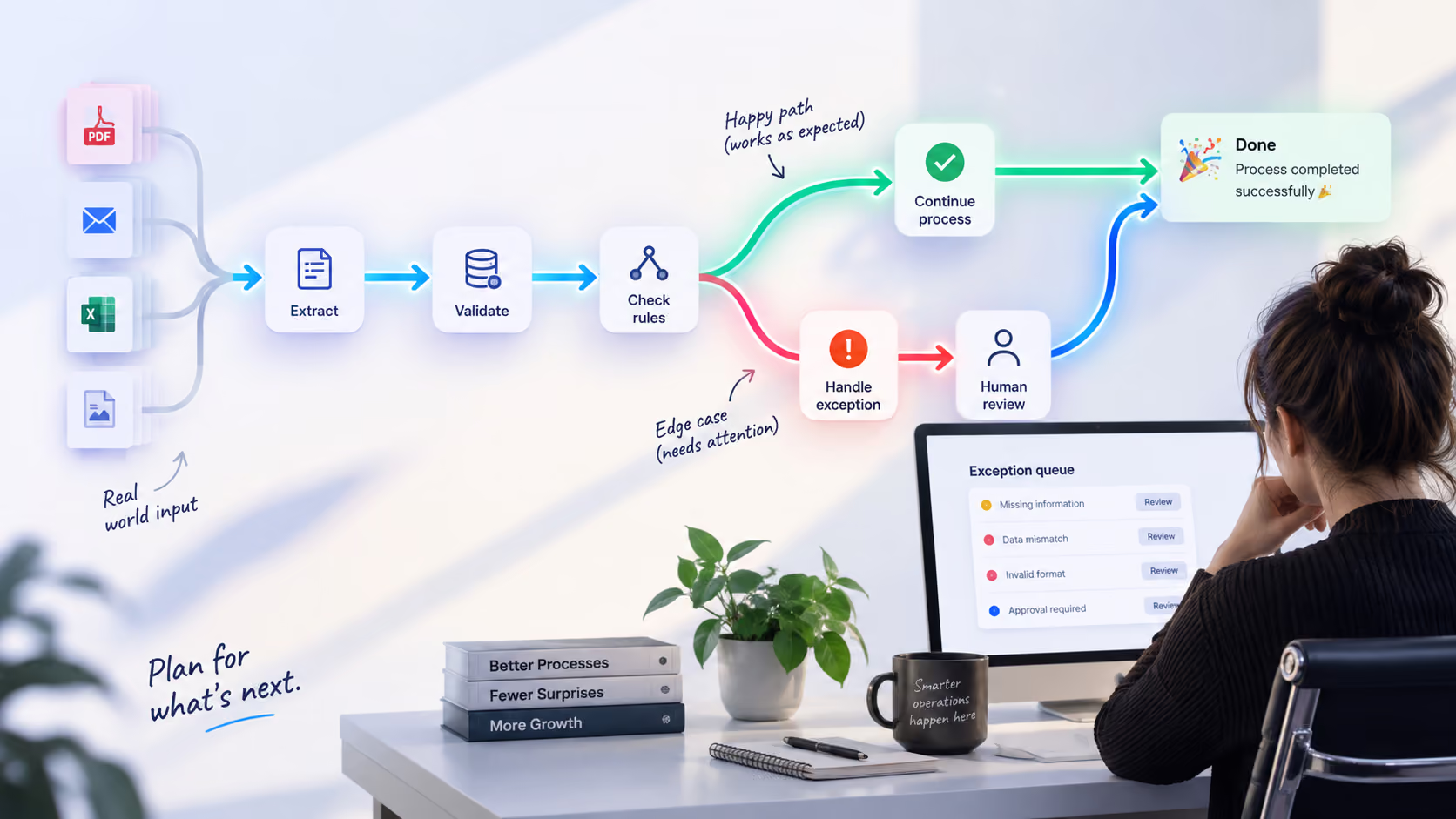
Data enters the system → AI analyzes it → a risk or opportunity is identified → AI prepares a recommendation → a person reviews and approves it → automation carries out the action → the outcome is recorded.
.avif)
The Central Hub provides the shared operational layer that connects these steps. It can bring together information from different parts of the business, give AI access to the context it needs, and keep decisions and outcomes connected to the underlying operational data. Once a decision is approved, automation can carry out the next steps without requiring someone to manually move information between systems.
For example, an AI agent could identify that inventory is likely to fall below a predefined level and prepare a replenishment recommendation. A manager reviews and approves it. The automation layer creates the purchase order, sends the relevant notification, and records the transaction.
This creates a practical form of decision automation while keeping the approval point with the person responsible for the process. The decision, the action, and the result are all part of the same operational record. This also creates a feedback loop. When people change or reject AI recommendations, those decisions can be recorded and reviewed. Over time, the organization gains a clearer picture of how decisions are actually made and where its rules or workflows need to change.
AI works best when it has a reliable operational foundation. If data is fragmented and processes are inconsistent, adding AI does not automatically solve those problems. It can simply make the existing complexity harder to manage.
This is why Atomic Actions approaches AI as part of a broader Business Operating System. The Central Hub connects operational data and workflows first, creating the environment in which AI operational intelligence and automation can work together.
BCG's research supports this broader approach. Companies it identifies as "future-built" are five times more likely to have reshaped workflows end to end rather than focusing only on isolated automation or AI projects. The research also points to clear decision rights, business and IT ownership, and measurement of AI value as important elements of successful implementation.
What Operations Teams Can Gain
The value of AI decision support is not limited to the time spent using an AI tool. The bigger opportunity is reducing the amount of operational work that happens before a decision can be made. Depending on the workflow, organizations can see improvements in areas such as:
- Time saved: less manual reporting, reconciliation, and data preparation
- Decision speed: shorter time between an operational issue appearing and someone acting on it
- Consistency: recommendations based on the same data and predefined criteria
- Risk visibility: earlier identification of anomalies and potential problems
- Scalability: teams can handle more operational volume without increasing manual analysis at the same rate
For example, one food and beverage client reported 70% less manual administrative work and a 60% faster operational response after centralizing inventory, inspections, order notifications, and reporting in a single hub with AI-powered monitoring.
The broader numbers also show why companies are investing in this area. BCG's 2025 research found that future-built companies achieve 1.7 times more revenue growth and 1.6 times higher EBIT margins than laggards. The research also found that 70% of AI value is concentrated in core business functions such as manufacturing, supply chain, and pricing.
Gartner expects intelligent agents to become increasingly common in supply chain operations as well. By 2030, 50% of cross-functional supply chain management solutions are expected to use intelligent agents to autonomously execute decisions across the ecosystem, while by 2028, 25% of supply chain KPI reporting is expected to be powered by GenAI models.
Where to Start With AI Decision Support
You do not need to introduce AI across every operational process at once. A better starting point is usually one decision that happens regularly, takes significant time to prepare for, and has a clear outcome.
Good candidates might include:
- Daily production planning
- Weekly procurement decisions
- Project milestone risk assessment
- Inventory replenishment
- Margin monitoring
- Operational exception management
These are good candidates for process analytics because the workflow, inputs, decision criteria, and outcomes can usually be identified and measured. Once you have selected a workflow, map out where the information comes from, how the decision is currently made, who approves it, and what happens afterward.
This gives you a much clearer starting point for AI. Instead of asking, "Where can we use AI?", you can ask a more useful question: "Which part of this decision process takes the most manual work, and which parts can be supported by AI?" Gartner recommends that supply chain organizations develop a formal AI strategy with clear objectives, measures of success, and implementation priorities. As of June 2025, only 23% of supply chain organizations reported having such a strategy.
For an initial deployment, it also makes sense to keep human approval explicit. AI can aggregate information, identify patterns, and prepare a recommendation while the person responsible for the process decides whether to act on it.
The first metrics should be practical:
- How much time does the team spend preparing for the decision?
- How long does it take to make the decision?
- How many relevant risks or exceptions are identified?
- How often are recommendations changed or rejected?
- What happens to the operational outcome after implementation?
Tracking these measures makes it possible to evaluate whether AI is actually improving the workflow rather than simply adding another tool. BCG's research found that future-built companies are six times more likely to rigorously track AI value across the organization than lagging companies. Measurement should therefore be part of the workflow from the beginning, not something added after deployment.
AI Should Make Decisions Easier, Not Remove People From Them
The practical value of AI in operations comes from reducing the work required to make a decision. AI can gather information from multiple systems, identify patterns that deserve attention, monitor operational metrics continuously, and prepare recommendations. People can then add context, evaluate trade-offs, approve actions, and remain accountable for the outcome.
This is the core of AI assisted decision making: technology handles more of the analysis, while people retain the judgment and accountability that come with operational decision making. In a connected operational environment, the process becomes:
- AI prepares the information. People make the call.
- AI monitors continuously. People focus on exceptions.
- AI generates recommendations. People validate and adjust them.
- AI and automation handle routine follow-up. People remain in control of the workflow.
- The Central Hub records decisions and outcomes so the organization can learn from them.
Deloitte's research on human decision-making with AI makes a similar point: technology can accelerate analysis and clarify uncertainty, but it cannot replace the human judgment, purpose, and values behind a decision.
The goal, then, is not to make every operational decision autonomous. It is to remove unnecessary analysis and manual coordination from the process so people can spend more time on the decisions that actually require their judgment.
When AI, automation, and a Central Hub work together, the result is a shorter path from information to action. Operational data becomes AI business insights, recommendations become part of the workflow, and decisions and outcomes become part of the organization's operational knowledge.
If your team spends more time collecting and reconciling information than acting on it, it may be time to rethink the workflow. Atomic Actions can help connect your systems, centralize operational data, and build AI-powered workflows that support faster, better-informed decisions.
.avif)